Dr. Gregory L. Plett: Welcome! | |
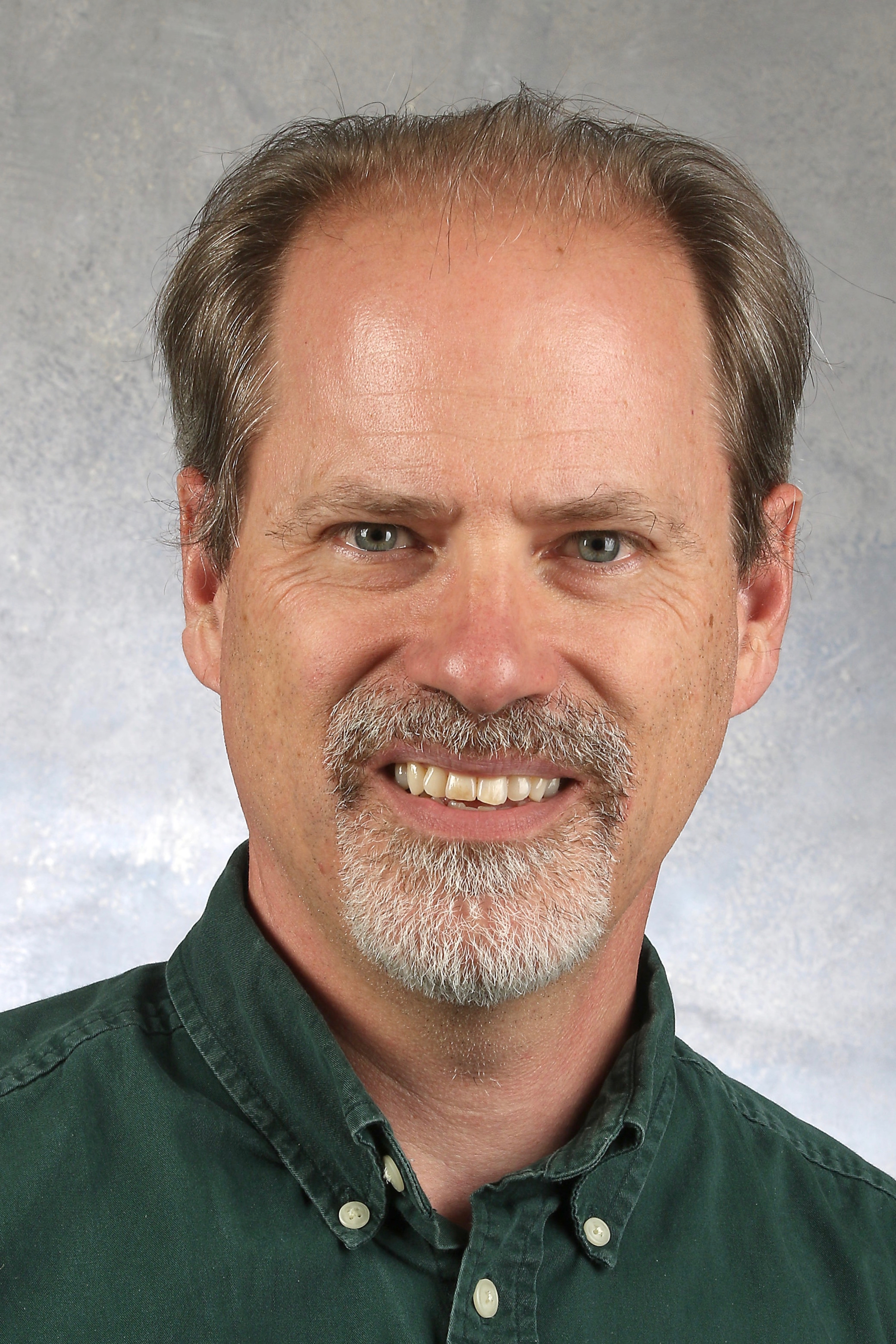 | Through this page you may access the home pages for the courses that I teach, and the public portion of my professional dossier (including links to research publications).I received my B.Eng. degree in Computer Systems Engineering from Carleton University (Ottawa, Canada) in 1990, and my M.S.E.E. and Ph.D. degrees in Electrical Engineering from Stanford University (Stanford, CA) in 1992 and 1998, respectively. I joined the faculty of the University of Colorado at Colorado Springs (UCCS) in the Fall semester of 1998, and am now Professor of Electrical and Computer Engineering. I am a senior member of the IEEE and life member of the Electrochemical Society. My research is now largely done in collaboration with Prof. Trimboli at UCCS. We are focused on research in control systems as applied to the management and control of high-capacity battery systems, such as found in hybrid and electric vehicles. Current research efforts include: physics-based reduced-order modeling of ideal lithium-ion dynamics; system identification of physics-based model parameters using only current-voltage input-output data; physics-based reduced-order modeling of degradation mechanisms in electrochemical cells; estimation of cell internal state and degradation state; state-of-charge, state-of-health and state-of-life estimation; power and energy prediction using model predictive control and other advanced techniques to extend life; battery pack fast charging. Research is both theoretical and empirical: the UCCS high-capacity battery research and test laboratory houses equipment to test cells, modules, and battery packs, and is home to our own custom battery-management system and our own battery pack simulator projects, which enable cutting-edge research in advanced but practical algorithm prototyping. Courses and programs in control systems and specializing in battery controls support this research effort by educating qualified researchers. Feel free to peruse my statement of faith. |
Graduate Offerings in Electric Drivetrains and Battery Controls | |
| IDEATE | See the homepage for the GATE Center of Excellence in “Innovative Drivetrains in Electric Automotive Technology Education” (IDEATE). |
Public Portion of Professional Dossier | |
| Welcome | Dossier “Welcome” page [Updated infrequently] |
Open Research Positions | |
| Open Positions | This page lists current open research assistant programs that I direct, if any are presently available. |
Courses I Teach (and Related by Prof Trimboli) | |
| ID101 | Freshman Seminar: Mindstorms |
Remember Star Wars' R2D2 and 3CPO? For years, movies have explored the world of robots. Could robots actually take over the world? Maybe not, but these marvelous machines are becoming more and more capable. Just how do humans and robots differ? Can robots actually see, play soccer, vacuum the living room, or collect the trash? This freshman Seminar course will teach you basic technology common to robots, as you and your teammates design and build one of your own. |
|
| ECE1001 | Introduction to Robotics |
An introductory course presenting foundational material in the design of robots. Topics include basic properties of sensors, motors, gears, drive mechanisms, control schemes, and processors to guide and control robots. LEGO kits will be used to implement student designs. Prer., NONE. Any engineer or non-engineer is encouraged to enroll. | |
| ECE2205 | Circuits and Systems I |
Modeling and analysis of analog circuits and linear systems. Kirchoff's current and voltage laws. Uses time-domain methods and s-domain transfer functions to solve differential equations of first and second order RLC circuits with op amps. Transient and steady-state response to steps and complex exponentials. Zero-input, zero-state, and initial-state response. Introduction to circuit simulation. Prer., ECE 2610 | |
| ECE2610 | Introducton to Signals and Systems |
Mathematical representation of signals and systems; spectrum representation; representation of signals by sample values; discrete-time filter characterization and response; the z-transform; continuous-time signals and linear, time-invariant systems; frequency-response; continuous-time Fourier transform and applications to system analysis. MATLAB basics with application to signals and systems. Includes lectures, demonstrations, and laboratory assignments. Prer., Math 1360 and ECE1021 | |
| ECE3510 | Linear Systems Theory |
Characterization of linear systems by impulse response, convolution, transfer function. Linear differential equations and linear difference equations as models. Applications to circuits, electromechanical systems, etc. Transform methods include: Fourier series, Fourier transforms, and Laplace transforms. Introduction to state variables and the state-transition matrix. Use of a variety of models in design. Prer., ECE2220 and MATH340[This course is no longer offered. The ECE2220/2230/3510 sequence was replaced by ECE2610/2205/3205.] | |
| ECE3610 | Engineering Probability and Statistics |
An introduction to probability and statistics with application to solving engineering problems. Includes the axioms of probability, random variables, density functions, distribution functions, expectations. Gaussian random variables, bivariate random variables, sums of independent random variables. Estimation of sample mean and variance. Monte Carlo simulation, binomial, hypergeometric, Poisson counting process, Erlang model and applications to telephone calls, etc., introduction to queues, confidence intervals, reliabilty, failure rates, the Weibull model, the log-normal model, estimation using regression. Introduction to random processes. Involves a project making use of simulation of random variables on a computer. Prer., Math2350 | |
| ECE4510/5510 | Feedback Control Systems |
Linear analysis and analog simulation of electrical, chemical, hydraulic, and mechanical systems using block diagrams and signal-flow graphs. Comparison of open- and closed-loop configuartions. Feedback control system design using Nyquist, Bode, and root-locus methods. Effects of simple networks on system response. Introduction of state-variable techniques and digital computer solutions. Prer., ECE2205 or equiv.Click here to access lecture notes and videos | |
| ECE4530 | Feedback Control Laboratory |
Introductory experiments on response of control system components. Open-loop and closed-loop (feedback) response of servo systems. Simulation of systems on analog computer. Design of compensator systems. Coreq., ECE4510 | |
| ECE4540/5540 | Digital Control Systems |
Theory and application of classical and modern discrete-time control systems. Analysis and design of discrete-time and hybrid control using z-transforms, root locus, frequency domain and state-variable compensation techniques. On-line implementation by digital computers will be studied. Prer., ECE4510Click here to access lecture notes and videos | |
| ECE4560 | Digital Control Laboratory |
Discrete-time control systems will be designed and tested using microcomputers, compensators, A/D and D/A converter analog computers. Experiments in the control of discrete and analog systems will be performed. Coreq., ECE4540[This lab is no longer offered on a regular basis.] | |
| ECE4899 | Electrical Engineering Design Project |
A project lab taken during the last semester of the senior year for the design of system components and systems in the areas of communications, computer engineering, controls, digital signal processing, electromagnetics, microelectronic fabrication processes, or CMOS integrated circuits. Students will identify, select, and complete a design project. Design specification, analysis, design, simulation and/or construction of a successful project is required for completion of the course. Prer., ECE4890 and last semester of degree | |
| ECE4520/5520 | Multivariable Control Systems I |
Fundamental aspects of modern control theory are covered, including solutions to systems modeled in state-variable format, controllability, observability, pole placement, and linear transformation. Computer based tools for control system design are used. Prer., ECE4510 and MATH3130 (or equiv.)Click here to access lecture notes and videos | |
| ECE5530 | Multivariable Control Systems II |
Design of systems in state variable format are covered including linear quadratic regulators, state estimators, model-reference compensators, and H∞ control. Computer tools are used. Prer., ECE4520/5520Click here to access lecture notes and videos | |
| ECE5550 | Applied Kalman Filtering |
Theory and application of Kalman filters for state estimation, information fusion, multitarget tracking, and data asociation. Special focus on the discrete linear Kalman filter, the extended Kalman filter, and the unscented Kalman filter. Practical issues related to robust performance are studied. Prer., Math 3810 or ECE3610, and Math 3130 (or equivalent).Click here to access lecture notes and videos | |
| ECE5560 | System Identification |
Modern methods for identifying mathematical models of systems from observations of their behavior; input-output and state-space models; parametization and identifiability; non-parametric methods; prediction and output error methods; recursive estimation; Kalman filters; order estimation; subspace identification. Prer., Math 3400, MATH 3130, ECE2205, ECE3610 (or equivalent).Click here to access lecture notes and videos | |
| ECE5570 | Optimization for Systems and Control (Taught by M. Scott Trimboli) |
Optimization methods: parameter optimization, interior point methods, quadratic programming, constrained optimization, optimization for dynamic systems, optimal control and numerical methods. Engineering applications, especially control. Prer., MATH 3130, MATH 3400, or equivalent. Meets with DASE 4570.Click here to access lecture notes and videos | |
| ECE5580 | Multivariable Frequency Domain Control (Taught by M. Scott Trimboli) |
Practical feedback control for linear multivariable systems from a frequency domain perspective. Development of useful techniques for analysis and design of control systems for multiple-input- multiple-output (MIMO) plants treating system uncertainty as an important aspect of design. Addresses robust stability and performance. Prer., ECE 4520 or ECE 5520 or equivalent.Click here to access lecture notes and videos | |
| ECE5590 | Model Predictive Control (Taught by M. Scott Trimboli) |
Introduces fundamental model predictive control concepts and demonstrates how they are applied in the design and control of systems and processes. Covers modeling, constraint handling, and stability; addresses options in regard to algorithms, models, and complexity versus performance issues. Prer., ECE 4520 or ECE 5520 or equivalent.Click here to access lecture notes and videos | |
| ECE5710 | Modeling, Simulation, and Identification of Battery Dynamics |
Derives mathematical models of the electrochemical dynamics of battery cells, including thermodynamic and kinematic properties, at multiple scales. Modern, lithium-ion chemistries are emphasized. Students will use simulation software and will use lab-test data to create and validate parameterized models. Prer., ECE2205, MATH2350, MATH3400 or equiv.Click here to access lecture notes and videos | |
| ECE5720 | Battery Management and Control |
Considers design of battery management systems: basic thermal and high-voltage electrical control, architectures for modular design, and different methods for cell equalization. Algorithms for estimating state-of-charge and state-of-health will be studied in depth. Students will implement their own software designs. Prer., ECE4710/5710.Click here to access lecture notes and videos | |
| ECE5730 | Physics-Based Battery Management Systems Algorithms |
Considers battery-management-system algorithms using physics-based models of Li-ion cells. Develops lumped-parameter and impedance models, system-ID techniques, time-based simulations. Application to state and health estimation, fast charge, power-limits calculations. Prer., ECE4710/5710, ECE5720.Click here to access lecture notes and videos | |
Laboratories that I Manage | |
| Battery Research Lab | See also the homepage for the High-Capacity Battery Research and Test Laboratory |
| Control-Systems Lab | See also the homepage for the Control-Systems Laboratory |
Contact Information | |
 |
Dr. Gregory L. Plett, Professor, |
Last updated:

1420 Austin Bluffs Pkwy, Colorado Springs, CO USA 80918
719-255-8227 (UCCS), 800-990-8227